Lifecycle assessment
Knowing where they stand.
A sample marketing assessment that starts with where the company sits in its lifecycle, so the opportunities, the challenges, and the priorities are clear from the jump.
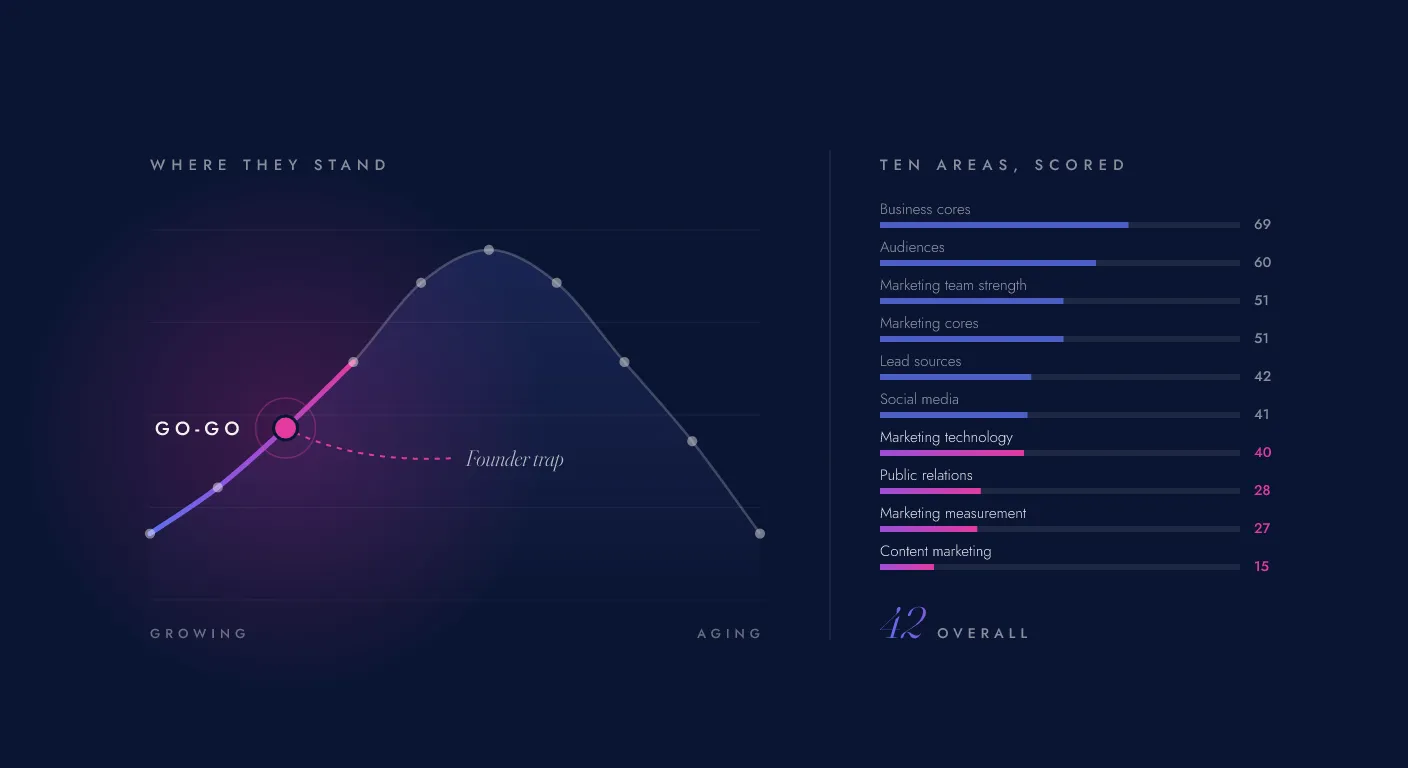
Why I start with the lifecycle
Every company goes through predictable growth stages, and each one comes with its own opportunities and its own growing pains. Once I know where a company sits in that lifecycle, I can say which challenges are normal, which are warning signs, and which marketing efforts deserve attention first.
That changes the conversation. Instead of grading a company against a perfect ideal, the assessment measures it against what is realistic for its stage. You wouldn't expect a start-up to have robust marketing systems, and you wouldn't expect an aging company to tolerate unmeasured experiments.
What follows
This example is anonymized: the company name and dates are removed. It walks through the full assessment:
- The lifecycle stage, and what it predicts.
- The positive traits to build on, and the growing pains to plan for.
- A score across ten marketing areas, with one area shown line by line.
- The takeaways and the single recommendation that ties them together.
01 · The lifecycle
Where they stand.
Every organization moves through definitive growth stages, and each stage brings its own set of challenges. How well leadership handles them, and the transition to the next stage, shapes everything that follows.
For marketing, the stage shows which efforts, systems and processes need the most urgent attention: strategy, growth management, measurement or scale.
Go-Goaggressive growth
The organization has a successful product, rapidly growing sales and strong cash flow. With the chaotic start-up phase behind it, leadership is relieved to no longer worry about daily survival. That makes this both a heady and a dangerous time.
02 · Opportunities & challenges
What the stage predicts.
Problems are the natural result of growth. The faster a company moves from stage to stage, the faster and more urgently its growing pains appear. Naming them early is what makes it possible to prioritize.
Positive traits to build on
Customer instinct
An uncanny sense of what customers want, sometimes before the market knows it. Long-term employees begin to emulate the founder’s instinct.
Responsiveness
Unburdened by institutional memory, the company spots opportunity fast and pivots when competitors, regulation or technology shift.
Agility
Policies are still forming and roles aren’t rigid, so teams can adopt agile practices and ship high-value work faster than the competition.
Pride of ownership
Early employees carry an infectious pride in the company’s success, and their room to advance keeps productivity and healthy competition high.
Predictable growing pains
01Quick movement
Every opportunity is tempting. Taken to an extreme, speed undermines strategy, reshuffles people and budget, and invites missteps.
02Diversification
Too many irons in the fire, with fast commitments to ventures where the company has little expertise.
03Sales drives the ship
Marketing is wired for leads, sales for closed business. Unqualified leads make each side question the other.
04Everything is a priority
Important work that isn’t urgent gets deferred for the latest “hot” project, and strategies are set aside as fast as they’re declared.
05Crisis management
The vision is hard to articulate and warnings go unheeded, so a few people get things done while everyone else runs to keep up.
06Organized around people
Work goes to whoever has time or “gets things done.” Unclear assignments disappoint, leaders micromanage, and decisions bottleneck.
07Weak information systems
Systems cover operations, service and accounting. The measurements that prove marketing drives revenue don’t exist yet.
08Frustration
Shifting priorities and moving targets make progress feel impossible. New hires get little training, and turnover begins.
09Insufficient infrastructure
Processes grow in response to opportunity, not a plan, and there is never time to slow down and replace them properly.
03 · Challenge summary
Normal, or a warning?
Simply knowing these challenges are expected helps leadership walk through them. Left unaddressed, each one can push a company back a stage. At worst, they are fatal.
Normal for a Go-Go
Expected challenges
- Self-confidence and eagerness
- Everything is a priority
- Sales drive the ship
- Some sales accepted that can’t be delivered
- Sales valued over profits
- Unclear communications
- Unannounced or unproductive meetings
- Insufficient cost controls and ad hoc budgeting
- Founder indispensable to every decision
- Bottlenecked approvals
- Confusion about roles and responsibilities
- Staff frustration and turnover
- Infrastructure is a house of cards
- A crisis prompts more robust systems
Act now
Danger signs
- Blind arrogance
- Sustained lack of focus and ever-changing strategy
- Continued pursuit of non-core or unprofitable business
- Consistent inability to deliver quality
- Premature emphasis on profitability
- No one but the founder knows what is going on
- No meetings
- No cost controls, no budgeting
- Key leaders avoid managing in favor of doing
- Founder won’t hire people with complementary strengths
- Leadership can’t or won’t delegate
- Key people are leaving
- Collapsing infrastructure
- A crisis maims the company in the marketplace, or kills it
04 · Marketing assessment
Ten areas, one lens.
You wouldn’t expect a start-up to have robust measurement, or an aging company to allow many unmeasured experiments. So each of ten critical marketing areas is scored through the lens of the company’s stage. The goal isn’t to criticize. It is to choose the efforts with the most potential to move the business.
Overall result
42%
- Managed
- Consistently managed, measured or applied systematically. A natural strength of the marketing function.
- Neutral
- Appears to be done well, with little evidence of systematic application or measurement.
- Ad hoc
- Done on an as-needed basis, with little strategic application or measurement.
- Business cores69%
- Audiences60%
- Marketing team strength51%
- Marketing cores51%
- Lead sources42%
- Social media41%
- Marketing technology40%
- Public relations28%
- Marketing measurement27%
- Content marketing15%
Priority areas for improvement
- Managed
- 14
- Neutral
- 35
- Ad hoc
- 52
- Not in place
- 30
05 · A closer look
Marketing measurement.
Historical performance is the benchmark for everything else. If cost of acquisition isn’t tracked by channel, it is hard to forecast realistic budgets and goals, or to justify more resources.
Area score
27%
- Managed
- Neutral
- Ad hoc
- Not in place
| Metric | Rating | Status |
|---|---|---|
| Referrals | 8/10 | Managed |
| Revenue growth | 8/10 | Managed |
| Profitability | 7/10 | Neutral |
| Inbound job candidates | 6/10 | Neutral |
| Employee retention | 5/10 | Ad hoc |
| Customer retention | 4/10 | Ad hoc |
| Content downloads | 3/10 | Ad hoc |
| Social media reach | 3/10 | Ad hoc |
| Social media engagement | 2/10 | Ad hoc |
| Inbound links | 2/10 | Ad hoc |
| Cost of acquisition | 0/10 | Not in place |
| Customer lifetime value | 0/10 | Not in place |
| Lead quality scoring | 0/10 | Not in place |
| Lead volume | 0/10 | Not in place |
| Lead-to-sale conversion | 0/10 | Not in place |
| Subscribers | 0/10 | Not in place |
| Website traffic | 0/10 | Not in place |
Opportunities for improvement
- 01Universally accepted KPIs such as acquisition cost, lifetime value, retention and lead volume couldn’t be found.
- 02Funnel metrics like downloads, inbound links, reach and owned subscribers, which show progress at the top and middle, were missing too.
- 03Heavy spend on some tactics, without clear measurement, makes budget and staffing decisions hard to defend.
- 04Without measurement, success is hard to repeat, and marketing becomes the first cut when growth slows.
06 · Key takeaways
Where to start.
- 01
Marketing technology, public relations, measurement and content scored lowest. Key digital channels, from search and paid to social and premium content, averaged as areas for improvement.
- 02
Marketing automation and analytics were underused. High performers in automation see stronger lead-to-sale conversion and lower acquisition cost.
- 03
Gaps in content meant missed chances to generate and nurture leads.
- 04
Public relations was underused, with no content fueling earned media online or off.
- 05
Revenue-growth leaders win on measurement, powered by stronger social, lead sources, PR and content.
Recommendation
Institute marketing automation with built-in campaign measurement, paired with a lead capture and nurture program that closes the gap between sales and marketing.
The review is meant to repeat once a year, right after company results are in and the next year’s objectives are set, so the list of marketing improvements keeps pace with the company’s growth.
Next case study
Not just for firefighters.